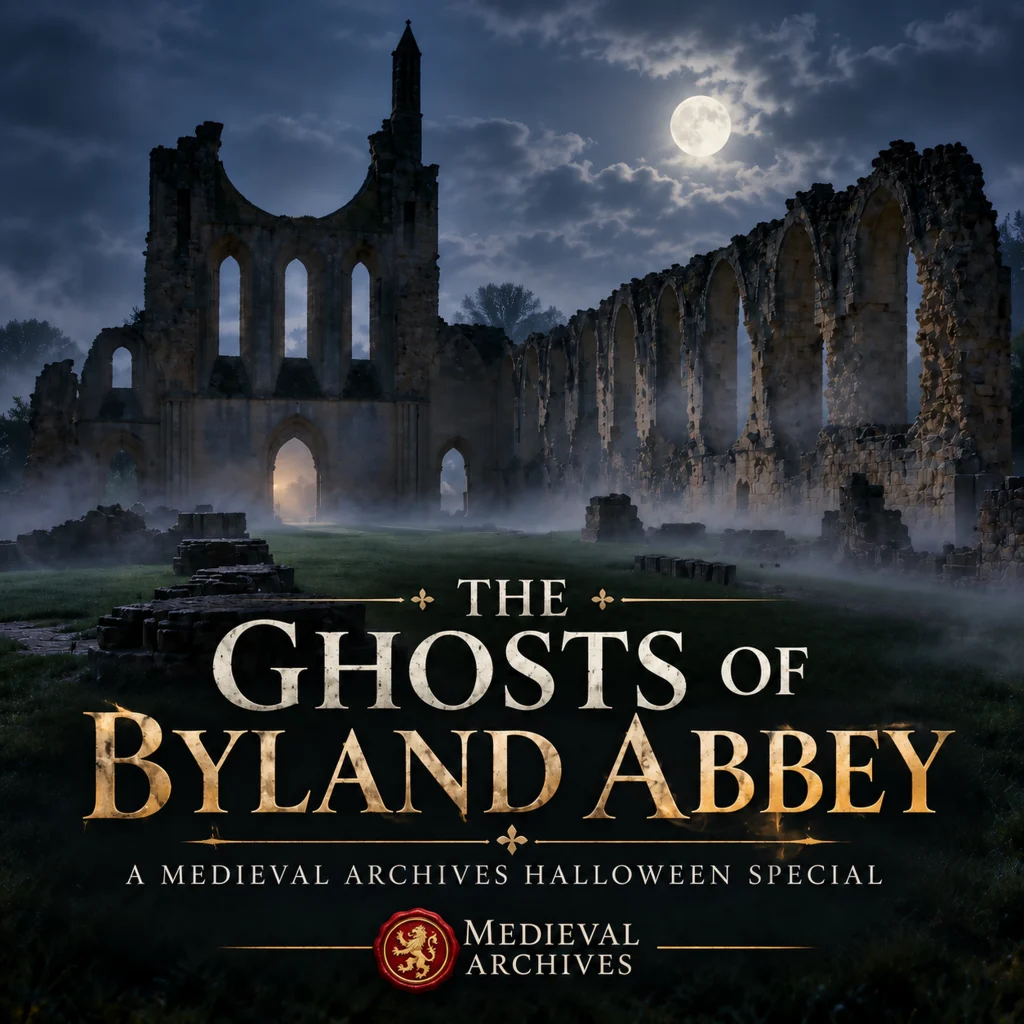
Listen: The Ghosts of Byland Abbey
On the Halloween edition of the Medieval Archives Podcast, we head to medieval Yorkshire and to discover the Ghosts of Byland Abbey, including Snowball the Tailor, the restless Robert of Kilburn, the wandering dead rector and several other spirits that refused to stay dead.
So pull up a chair, pour yourself a pumpkin-spiced ale, trust me, you’ll need it, and spend a little time with the dead. Or, more accurately, the dead who refused to die.
The Ghosts of Byland Abbey: Medieval Ghost Stories from Yorkshire
Around 1400, someone at Byland Abbey in Yorkshire began recording ghost stories. They were local stories about restless corpses, strange figures on lonely roads, shapeshifting spirits and dead people who refused to leave the living alone.
More than six hundred years later, the stories still survive.
Ghost Stories Hidden in a Medieval Manuscript
The tales appear in British Library Royal MS 15 A. XX, a manuscript associated with Byland Abbey. On several blank pages, a monk or other writer connected with the abbey recorded supernatural stories that seem to have circulated in the surrounding countryside.
M. R. James, one of the great English ghost-story writers, published the collection in 1922. He dated the additions to around 1400 and was struck by their local character, suggesting that the writer may have preserved something of the original storytellers’ words.
Some stories are detailed, others are fragments, and a few end before answering the most obvious question.
These Were Not Victorian Ghosts
The ghosts of Byland are not the pale, distant apparitions familiar from later ghost stories. They are physical, sometimes violent. They shove people from horses, tear clothing, follow travelers for miles and, in one case, have to be physically restrained while someone runs to fetch a priest.
One tale begins with a woman catching a ghost and carrying it into a house on her back. A witness claimed her hands sank into the spirit’s flesh as though the body were rotten and only partly solid. The story never explains why she brought the ghost home, which somehow makes it even better.
The Dead Had Unfinished Business
What connects many of these stories is not simply fear. The ghosts usually return because something from life remains unresolved. A sin needs absolution, a debt remains unpaid, stolen property must be returned, or someone has died while excommunicated.
These spirits may be frightening, but they are not always malicious. The living can question them, arrange Masses on their behalf, seek absolution for them or correct the wrong that keeps them from rest. Death has not ended the relationship between the living and the dead.
Strange Things on the Roads of Yorkshire
The stories are also wonderfully bizarre. A traveler carrying a sack of beans meets something that changes shape several times before offering to help him. A tailor named Snowball encounters a raven that throws sparks and knocks him from his horse, beginning one of the strangest stories in the collection.
Another man hears something following him through the darkness for several nights, calling “Hoo… Hoo… Hoo…” as it gets closer.
Elsewhere there is a dead rector whose body must be dug up and thrown in a lake. A group of young men who decide the solution to a corpse repeatedly leaving its grave is simply to catch it.
More Than Scary Stories
One of the most memorable tales follows a pilgrim named Richard Rowntree, who sees a procession of the dead while keeping watch beside a road. Among them is a small child, and what follows becomes a story about grief, family and something the man never knew.
Whether anyone around Byland Abbey actually encountered one of these spirits is something we don’t know. What we do know is that people told these stories, remembered them and recorded them. They give us more than medieval scares; they are concerns about debts, religious obligations, family disputes, guilt and the fear that some wrong might follow a person beyond the grave.
Sources
British Library. Royal MS 15 A XX. London: British Library, fols. 140b–143, 163b–164.
Caciola, Nancy. “Wraiths, Revenants and Ritual in Medieval Culture.” Past & Present, no. 152 (August 1996): 3–45.
James, M. R. “Twelve Medieval Ghost-Stories.” The English Historical Review 37, no. 147 (July 1922): 413–422.
Schmitt, Jean-Claude. Ghosts in the Middle Ages: The Living and the Dead in Medieval Society. Translated by Teresa Lavender Fagan. Chicago: University of Chicago Press, 1998.
Simpson, Jacqueline. “‘Repentant Soul or Walking Corpse?’ Debatable Apparitions in Medieval England.” Folklore 114, no. 3 (2003): 389–402.