The Battle of Bouvines (1214): The Day France Was Born and England Lost an Empire
On Sunday, 27 July 1214, near the small village of Bouvines in northern France, one of the most consequential battles of the Middle Ages unfolded. Often overshadowed by famous clashes such as Hastings, Agincourt, or the battles of the Crusades, the Battle of Bouvines reshaped the political landscape of Western Europe. In a single afternoon, it determined the fate of the French monarchy, destabilized the Holy Roman Empire, and set England on the path toward the Magna Carta.
The Angevin Empire and the Rise of Philip Augustus
Since the reign of Henry II of England, the English kings ruled England and a sprawling collection of territories stretching across western France. The Angevin Empire included Normandy, Anjou, Maine, Touraine, and Aquitaine, making the English monarch one of the most powerful rulers in Europe.
Yet this empire contained a fundamental weakness. The English king was simultaneously a sovereign monarch in England and a feudal vassal to the King of France for his continental lands. This contradiction created constant tension between the two crowns.
When Philip II of France, known as Philip Augustus, ascended the throne in 1180, he set out to exploit the weakness. Philip proved to be one of the most capable rulers of the Middle Ages. Through diplomacy, legal maneuvering, and military force, he gradually dismantled the Angevin Empire. His greatest opportunity came during the reign of King John of England.
John’s reputation among contemporaries was poor. Medieval chroniclers portrayed him as suspicious, vindictive, and politically inept, earning him the nickname “Softsword.” Recognizing that he could not defeat Philip alone, John constructed a vast anti-French coalition that included the Holy Roman Emperor Otto IV, Ferrand, Count of Flanders, and numerous princes from the Low Countries and the German Empire.
The strategy was ambitious. John would invade France from the south through Aquitaine while Emperor Otto and the northern coalition marched toward Paris. Philip’s kingdom would be caught in the middle and crushed.
The plan nearly succeeded.
John’s Failure and Philip’s Opportunity
In early 1214, King John launched his southern campaign and initially achieved some success. However, his allies proved unreliable, and local support evaporated. When John suffered a setback at the Battle of La Roche-aux-Moines, he withdrew to Aquitaine, effectively abandoning the grand strategy.
This left the northern coalition to face Philip Augustus alone.
The allied army assembled under Emperor Otto IV was formidable. It included German knights, Flemish infantry, Brabant mercenaries, and English-financed contingents. It is estimated each side fielded between 6,000 and 10,000 men.
Philip understood he could not afford delay. If the coalition captured Paris or linked up with additional allies, his kingdom might collapse. On 27 July, the French king intercepted Otto’s army near the village of Bouvines, close to the River Marque.
The Battle: A King in the Melee
The battlefield favored the French. The terrain consisted of a narrow plain bordered by marshland and waterways, limiting the coalition’s ability to exploit its numerical advantages or conduct wide flanking maneuvers.
Both armies were arranged in three divisions: left wing, center, and right wing. Philip himself commanded the French center, facing Emperor Otto directly.
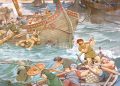
The fighting quickly devolved into the brutal chaos characteristic of medieval combat. Battles between armored knights were not elegant affairs of heroic duels. They were violent, exhausting struggles fought amid clouds of dust, shattered lances, screaming horses, and desperate hand-to-hand combat.
At one of the most dramatic moments of the battle, German infantry managed to penetrate the French center. Using hooks and polearms, they pulled Philip Augustus from his horse. For a few terrifying moments, it appeared that the King of France might be killed or captured. His household knights, however, fought their way through the melee, rescued their monarch, and remounted him on a fresh horse.
To French soldiers, it demonstrated that their king was willing to share the dangers of battle alongside his men. Medieval chroniclers portrayed Philip’s survival as evidence of divine favor.
The French command structure demonstrated a degree of discipline that was unusual for medieval armies. Rather than launching one massive, chaotic charge, French cavalry units were committed in successive waves, allowing exhausted knights to rotate out of combat while fresh forces maintained pressure.
The Collapse of the Coalition
On the French right, fierce fighting resulted in the capture of Ferrand, Count of Flanders, one of the coalition’s principal leaders. On the opposite flank, another allied commander, Renaud of Boulogne, resisted but was eventually overwhelmed.
As reports of these defeats spread, morale within the coalition army began to collapse.
In the center, Emperor Otto IV found himself increasingly isolated. According to contemporary accounts, his horse was killed beneath him, and he narrowly escaped capture. Recognizing the battle was lost, Otto fled the field. In his haste, he abandoned his imperial dragon standard, which the victorious French later presented to Philip Augustus as a trophy.
By evening, the coalition army had disintegrated. What had begun as one of the greatest military alliances of the Middle Ages ended in catastrophic defeat.
The Aftermath: Three Thrones Shaken
For France, the battle of Bouvines represented a transformative victory. Philip Augustus returned to Paris to celebrations that reportedly lasted an entire week. More importantly, he had secured the authority of the Capetian monarchy and demonstrated that the French crown could defeat the combined might of Europe’s greatest rulers.
For the Holy Roman Empire, the defeat proved disastrous. Emperor Otto IV’s authority collapsed almost overnight. Abandoned by many of his supporters, he was eventually replaced by his rival, Frederick II one of the most remarkable rulers of the medieval world.
For England, however, the consequences were perhaps the most significant of all.
King John’s grand strategy had failed utterly. He spent enormous sums financing the coalition and had recovered none of the territories lost to Philip. Returning to England humiliated, indebted, and politically weakened, John faced a nobility that had grown tired of military failure and crushing taxation.
Within a year, rebellious English barons forced their king to negotiate at Runnymede. The resulting agreement, the Magna Carta, would become one of the most influential political documents in history.
The Legacy: The Battle That Changed Europe
Despite its enormous importance, the Battle of Bouvines remains surprisingly obscure outside academic circles. English historians have often paid it little attention because it represented a devastating English defeat, while popular histories of the Middle Ages tend to focus on the Crusades or later conflicts such as the Hundred Years’ War.
Yet it is difficult to overstate Bouvines’ significance.
Had Philip Augustus lost, the French monarchy might have collapsed, leaving France fragmented among rival princes and foreign rulers. The Holy Roman Empire might have reasserted its dominance over Western Europe. Most remarkably of all, King John may never have faced the crisis that produced the Magna Carta.