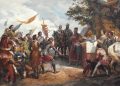
Louis VI French and Henry I of England at the Battle of Brémule (Gallica Digital Library, Public Domain)
The Battle of Brémule (1119): Chivalric Warfare and the Politics of Anglo‑French Rivalry
The Battle of Brémule, fought on 20 August 1119, is an unusual and important battle in the Middle Ages.
Often overshadowed by larger and more dramatic engagements, the battle provides valuable insight into the political tensions of the early twelfth century and the evolving norms of knightly conduct.
The battle between Henry I of England and Louis VI of France emerged from a dynastic dispute rooted in the aftermath of the Norman Conquest.
Early Context
The origins of the battle lie in the chaotic political landscape following the death of William the Conqueror. His sons, Robert Curthose, William Rufus, and Henry I, contested the division of their father’s territories, leaving Normandy and England in a state continuous instability.
By the early twelfth century, the rivalry had expanded to include Louis VI “the Fat” of France, who sought to weaken Henry I’s influence in France by supporting the claims of William Clito, the son of Henry’s older brother Robert.
The disputed region of the Vexin, a strategic borderland between Paris and Rouen, became the focal point of escalating tensions. Rather than large‑scale invasions, the conflict took the form of raids, castle sieges, and localized skirmishes.
In the volatile environment, the two monarchs unexpectedly encountered one another near the farm of Brémule, setting the stage for a rare direct confrontation between reigning kings.
Rise to the Battle
Henry I commanded approximately 500 knights, while Louis VI fielded around 400. Both armies consisted primarily of mounted knights, yet the Anglo‑Normans employed a tactic increasingly characteristic of their military doctrine: dismounting to fight on foot. This formation created a dense, disciplined defensive line capable of absorbing and repelling cavalry charges.
Louis VI, embodying the more traditional French emphasis on mounted shock combat, ordered a direct charge against Henry’s position. The attack proved ineffective. The French cavalry collided with the English line and became disorganized, leading to a rapid breakdown of their formation.
French Chronicles describe the battle as fierce and bloody where Louis the Fat fought side-by-side with his knights. While the battle was fierce, there were few casualties on either side.
Instead, it evolved into a series of close‑quarters engagements in which knights attempted to capture rather than kill their opponents.
Battlefield Dynamics
The conduct of the battle illustrates the economics of warfare. A captured knight represented a valuable source of income through ransom, whereas a slain knight offered no financial return and risked provoking retaliatory violence.
As a result, combatants frequently engaged in grappling, wrestling, and attempts to force surrender rather than lethal strikes.
Chronicler Orderic Vitalis famously claimed that only three knights were killed writing “… in the battle of the two kings, in which about nine hundred knights were engaged, only three were killed. They were all clad in mail and spared each other on both sides, out of fear of God and fellowship in arms; they were more concerned to capture than to kill the fugitives.”
The battle ended decisively in Henry I’s favor. Louis VI fled the field, reportedly becoming disoriented in nearby woodland before receiving assistance from a local peasant, while Henry captured approximately 140 French knights, including several prominent commanders.
The victory strengthened Henry’s hold over Normandy and ultimately compelled Louis to acknowledge Henry’s son as the legitimate heir to the duchy.
Legacy
The battle showcases a form of warfare shaped by shared warrior ethos, financial motivations, and ritualized behavior.
Born of dynastic rivalry and territorial dispute, it captures the political complexity of the early twelfth century and the emerging contours of chivalric practice. Its legacy underscores the structured, negotiated, and often pragmatic character of medieval combat.