Pope Nicholas I
Nicholas I “the Great” was the ninth century’s defining Pope, the figure who turned papal authority from an ideal into a force that kings and emperors had to reckon with. If Leo I was the Shield and Gregory I the Architect, Nicholas was the Iron in the foundation.
At a moment when Charlemagne’s empire was splintering and Europe was drifting toward chaos, Nicholas insisted that the Pope was not merely a spiritual shepherd but the supreme moral and legal authority over every ruler, East or West.
Early life and formation
Nicholas was born in Rome around the year 800 into a distinguished family; his father, Theodore, held the title of defensor, a civic and ecclesiastical office that carried both prestige and responsibility. His upbringing afforded him an excellent education, and he quickly became known for qualities that would define his later leadership, piety, benevolence, and deep knowledge of Church affairs.
His early service in the Church began under Pope Sergius II, who appointed him subdeacon, and continued under Pope Leo IV, who elevated him to deacon. These roles placed him at the heart of Roman ecclesiastical administration and prepared him for higher office.
Rise to the papacy
Nicholas was elected pope on 24 April 858, succeeding Benedict III. His election came at a time when the papacy was navigating complex political pressures from both secular rulers and competing ecclesiastical authorities.
Once in office, Nicholas asserted a bold vision of papal authority. He believed the pope held supreme moral jurisdiction over all Christians, including kings, and he acted accordingly. His papacy became known for decisive interventions in disputes involving royal marriages, episcopal appointments, and conflicts between secular and ecclesiastical powers.
The King’s Divorce: Nicholas vs. Lothair II
Nicholas’s most famous confrontation was with King Lothair II.
Lothair II, king of Lotharingia, wanted to discard his wife, Theutberga, and marry his mistress, Waldrada. To justify it, he accused Theutberga of incest. Local bishops, dependent on royal favor, granted the annulment.
Nicholas I refused to accept it. To him, it was a test of whether kings could bend divine law to their convenience.
Nicholas overturned the synods, deposed the archbishops who sided with Lothair, and ordered the king to restore his wife under threat of excommunication.
When Lothair’s brother, Emperor Louis II, marched on Rome to intimidate him, Nicholas didn’t flee or compromise. He fasted, prayed, and held his ground.
The emperor eventually backed down.
It was a stunning victory: a pope standing firm against royal power and winning. Nicholas had shown Christian morality applied to kings as surely as to peasants.
The Photian Schism: Rome vs. Constantinople
Nicholas’s assertiveness didn’t stop in Rome. In Constantinople, the emperor had deposed the legitimate Patriarch Ignatius and replaced him with the brilliant scholar Photius, a layman elevated at lightning speed.
Photius sought Nicholas’s approval. Nicholas saw an opportunity.
He declared Photius’s appointment invalid and demanded Ignatius’s reinstatement. The result was the Photian Schism, a fierce intellectual and political battle that widened the growing divide between East and West.
Nicholas’s justification was blunt:
“Since the whole body of the faithful looks to the Roman Church for the pure light of the faith, it is to her that all matters of importance must be referred.”
By claiming the right to judge the Patriarch of Constantinople, Nicholas was laying the foundations for the later medieval doctrine that the Pope was “Head of all Churches.”
Legacy
Nicholas I died on 13 November 867, contemporaries said he “tamed kings and tyrants, and ruled the world as if he were its lord.” The Papacy had become, in effect, a monarchy of the spirit.
Nicholas is the bridge between the ancient world and the high Middle Ages. He took the “Petrine Doctrine” of Leo I and turned it into an administrative reality.
- Church Autonomy: He fought to keep the Church independent from secular rulers.
- Moral Authority: His refusal to grant Lothair’s divorce established the Papacy as the guardian of Christian ethics.
- Roman Primacy: He ensured that the Latin West would look to Rome, not kings, not emperors, not Constantinople, for its identity.
Nicholas proved that the “Power of the Keys” was not a ceremonial metaphor. In his hands, it became iron. His leadership helped transform the papacy from a primarily local Roman institution into a central moral authority for Western Christendom.
His legacy endures in the Church’s understanding of papal primacy and its role in guiding Christian society, earning him the rare honorific “the Great,” shared only with Popes Leo I and Gregory I.
Read more articles in The Medieval Papacy series
🏰 Medieval Archives Weekly
Love stories like this? Every week we deliver papal struggles, forgotten battles and royal intrigue of the Middle Ages
2026 Special Feature
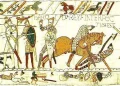
2026 marks the 960th anniversary of the Norman Conquest. To celebrate, our weekly newsletter is embarking on a year-long journey through the Bayeux Tapestry.
Every week, we “unroll” a new panel, decoding the secrets, the drama and the history of 1066.
Join thousands of fellow medievalists and sign up for free.