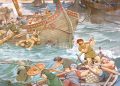
The Siege of Rhodes
In 1480, the Knights Hospitaller, one of the last Crusading orders still clinging to a foothold in the East, found themselves staring down the full weight of the Ottoman Empire. From their island stronghold of Rhodes, they had spent years running a relentless war at sea, hunting pirates and harassing Ottoman shipping. It was effective, disruptive, and to Mehmed II, fresh off his world-shaking victory at Fall of Constantinople, it was intolerable.
Mehmed reportedly called Rhodes a “nest of vipers,” and in 1480, he resolved to crush it. What followed was a full-scale invasion. The Ottomans assembled a massive force: some 160 ships and as many as 70,000 soldiers. Against them stood a tiny garrison, roughly 500 Knights and about 2,000 militia and mercenaries.
A Fortress Built for the Future
For decades, the Knights Hospitaller had studied the changing nature of warfare, especially the rise of gunpowder artillery that had already rewritten the rules at Constantinople. Under the leadership of Grand Master Pierre d’Aubusson, Rhodes had been transformed into something new, arguably the most advanced fortress in the world.
Gone were the tall, elegant medieval walls that had defined castles for centuries. In their place stood thick, sloped ramparts reinforced with massive earthen embankments. Where traditional stone walls would shatter under cannon fire, these new defenses were built to absorb the punishment. Cannonballs didn’t smash through, they buried themselves harmlessly in packed earth.
It was a quiet revolution in military engineering. And Rhodes would be its proving ground.
The Siege Begins
When the Ottomans arrived, they brought with them the most powerful artillery of the age, massive bronze cannons known as “basilisks,” capable of hurling 500-pound stone balls. These were the same weapons that had reduced Constantinople’s ancient walls to rubble just a generation earlier.
The bombardment of Rhodes began in earnest. Day after day, the guns roared. The most intense fighting occurred at the Tower of St. Nicholas, which guarded the harbor. After more than 1,000 heavy cannon shots, the Tower of St. Nicholas finally collapsed into a pile of rubble.
For most defenders, that would have been the end of the line.
For the Knights, it was just the beginning.
Fighting From the Ruins
Instead of retreating, the Knights adapted. They dug into the wreckage, transforming the collapsed tower into a makeshift fortress of wood, earth, and debris. It was crude, improvised, and incredibly effective. The Ottoman Janissaries, some of the best soldiers in the world, found themselves unable to scale or breach the chaotic defenses.
The siege ground on, brutal and unrelenting. Then, on July 27, the Ottomans launched their final, all-out assault.
What followed was chaos.
As waves of attackers surged forward, the Knights unleashed one of the more terrifying weapons of the siege: “fire-hoops,” rings soaked in oil and sulfur, set ablaze and rolled into tightly packed enemy ranks. Flames spread, formations broke, and the battlefield dissolved into close-quarters carnage.
At the center of it all was d’Aubusson himself. The Grand Master fought alongside his men, rallying defenses and holding the line. He was wounded, at least five times, according to contemporary accounts, but refused to leave the field.
The Ottoman Withdrawal
By August, the Ottomans had had enough. Their assaults had failed. Their casualties were mounting. And the “invincible” artillery that had once toppled empires had been blunted by something as simple (and as revolutionary) as dirt and geometry.
The Ottomans withdrew.
For Europe, the defense of Rhodes felt like a miracle. The Ottoman “Gunpowder Empire,” had been stopped cold. Not by numbers. Not by luck. But by preparation, innovation, and sheer stubborn resilience.
The Legacy of Rhodes
The victory at Rhodes saved the island and it changed the future of warfare.
The Knights Hospitaller held Rhodes for another 42 years, until a second, even larger Ottoman siege in 1522 finally forced their departure. But in those intervening decades, they refined what they had started. The lessons learned in 1480 evolved into a new style of fortification: the Trace Italienne, or star fort.
This Trace Italienne design became the dominant form of military architecture across Europe for the next three centuries, from the wars of Renaissance Italy to the age of Napoleon Bonaparte.