The Battle of Ane
In the early 13th century, the Prince-Bishop of Utrecht, Otto II of Lippe, ruled the northern Netherlands with the confidence of a crusader and the authority of a lord. A veteran of the Crusades and a man of high noble birth, Otto believed deeply in the feudal order of society. So when the peasants and minor landholders of Drenthe refused to pay their taxes and asserted their autonomy, he viewed it as a rebellion and as a sin against God’s hierarchy.
Determined to make an example of them, Otto raised a punitive force of roughly 300–500 heavily armored knights, supported by infantry. Their mission was simple: march into the marshlands and crush the “insolent” peasants who dared defy him.
The Drenthers, led by the local noble Rudolf II van Coevorden, understood exactly what they were up against. They could never meet knights in open battle. Their strength lay in numbers, around 2,000 farmers armed with iron tipped pikes, flails, and repurposed agricultural tools, and in their intimate knowledge of the land.
The Lure of the Bog
Near the village of Ane, the landscape turned treacherous. What looked like solid meadow was actually a patchwork of quaking bogs, soft peat that could swallow a man, let alone a warhorse weighed down with steel.
Rudolf chose his ground carefully. He positioned his men on a small island of firm soil beyond a wide stretch of marsh. When Otto’s army arrived, the knights saw only a ragged line of peasants and assumed the day would end in a swift, glorious charge.
The knights charged forward.
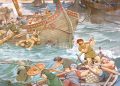
The moment the cavalry hit the bog, the illusion shattered. Horses plunged into the peat, sinking belly deep. The momentum of the charge died instantly. Knights struggled to dismount, their armor dragging them down as they floundered in the sucking mud. What had begun as a display of chivalric might dissolved into chaos.
The Drenthers advanced across the marsh, wearing simple clothing and “mud shoes,” wooden boards strapped to their feet to spread their weight. They moved where the knights could not. With their long hooks they dragged armored men from their saddles; with flails they struck at the gaps in helmets and visors. The bog became a killing ground.
Aftermath & Legacy
By the end of the fighting, Otto II and much of his knightly elite lay dead in the peat. Contemporary accounts describe the bishop being captured, tortured, and killed, his throat cut in the mud he had sought to dominate. More than 400 knights were lost, an almost unthinkable blow to the regional power structure.
The shock rippled through the Holy Roman Empire. Drenthe, written off as a backwater of stubborn peasants, had annihilated a feudal army through terrain mastery, discipline, and sheer determination. Their independence endured for nearly a century afterward.
The Battle of Ane rarely appears in textbooks, perhaps because it lacks the romantic sheen of knightly valor. Instead, it offers something more honest: a glimpse of medieval warfare as it truly was, brutal, local, and shaped as much by mud and marsh as by swords and banners.
In many ways, Ane foreshadowed later triumphs of infantry over cavalry, such as Morgarten and Bannockburn, where terrain and tactics proved stronger than armor and aristocracy.