The Battle of Fimreite
Norway in the late 12th century was defined by a brutal, multi-generational civil war. By 1184, the conflict had narrowed down to two men: King Magnus V Erlingsson, the traditionalist backed by the Church and the aristocracy. Sverre Sigurdsson, a former priest from the Faroe Islands who claimed to be the secret son of a previous king, Sigurd II, led a revolutionary movement that challenged everything the nobles believed they controlled.
Sverre’s followers, the “Birkebeiners” (Birch-legs), were initially so poor they wrapped their legs in birch bark for shoes and warmth. What they lacked in wealth, they made up for in discipline and the tactical brilliance of their leader. Sverre refused to fight like a noble; he fought to win.
A Fjord Becomes a Battlefield
In June 1184, the two rivals met in the Sognefjord, near the farm of Fimreite. Magnus held the numerical advantage, commanding a fleet of 26 ships, many of them large and heavily manned. Sverre had only 14 ships, but among them was his secret weapon: Mariasuda, an enormous longship that exceeded the size of anything else on the water.
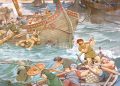
Medieval Scandinavian naval warfare relied on a distinctive tactic: lashing ships together to form a single floating platform. . This allowed warriors to fight in a unified shield wall and prevented enemy ships from isolating and boarding individual vessels. Magnus, confident in his numbers, lashed his entire fleet into one massive block.
Sverre did the opposite. He kept his ships loose and mobile, darting around the edges of Magnus’s formation and refusing to be pinned down.
The Fatal Tactic
The turning point came when Mariasuda closed in on the outer edge of Magnus’s floating fortress. The ship’s towering height allowed Sverre’s archers to fire down into the packed ranks of Magnus’s men, who had no way to return fire effectively. Under the relentless rain of arrows, panic spread.
Warriors on the outer ships began abandoning their positions, leaping inward toward the center of the formation in a desperate attempt to escape the slaughter. But the ships were lashed together. As hundreds of armored men crowded onto the central vessels, the overloaded ships began to sink.
One ship went down, then another, and another. The entire formation, bound together by its own tactical doctrine, began to drag itself under.
Magnus, realizing the battle was lost and his flagship was going down with the rest, threw himself into the fjord in a final attempt to reach shore. The weight of his armor pulled him beneath the water. The king who had been crowned with the Church’s blessing drowned in the fjord as his collapsing fleet watched helplessly.
Aftermath & Legacy
Sverre Sigurdsson was the victor and now, the undisputed King of Norway. The old aristocracy suffered catastrophic losses; entire noble lineages were destroyed in a single afternoon. With his enemies gone, Sverre built a more centralized monarchy and elevated his once ragged Birkebeiners into a new ruling elite, fundamentally changing the social structure of the kingdom.
Despite its significance, Fimreite is often overlooked. It stands as one of the most consequential naval battles in Scandinavian history. It demonstrated in the confined waters of a fjord, mobility could defeat mass, and tradition, could become a fatal weakness.
The battle also marked the end of an era for the old Norse aristocracy. The sheer loss of life among the noble families at Fimreite allowed Sverre to build a new, more centralized monarchy.