Pope Urban II
Pope Urban II (1035–1099), born Odo of Châtillon, is remembered primarily as the pope who launched the First Crusade, a military campaign that reshaped medieval geopolitics, Christian–Muslim relations and the identity of the Western Church. His papacy (1088–1099) expanded the reforms begun by Gregory VII and strengthened the papacy as a political and spiritual power.
Early Life and Background
Urban II was born around 1035 in the Champagne region of France to a noble family. He received his early education in Soissons and Reims, rising to become archdeacon of Reims, a powerful clerical office in medieval France. His experience there immersed him in Church administration and reform movements.
Seeking deeper religious commitment, he became a monk and later prior at Cluny, the leading monastic reform center. While at Cluny, Urban embraced ideals of ecclesiastical purity, discipline, and moral renewal, values that would define his papacy. In 1079, he was appointed Cardinal‑Bishop of Ostia by Pope Gregory VII and became a firm supporter of the Gregorian Reform agenda.
Rise to the Papacy
Urban’s loyalty to Gregory VII during the Investiture Controversy and his administrative ability earned him prominence among the reformist clergy. After the death of Gregory VII and then his successor Victor III, Odo was elected pope by acclamation on March 12, 1088, taking the name Urban II.
His election occurred amidst schism and political turmoil, with the antipope Clement III still claiming papal authority under imperial backing. Urban worked tirelessly to consolidate legitimate papal leadership and extend reform.
The Papacy: Major Actions and Policies
Ecclesiastical Leadership and Reform
Urban II continued Gregory VII’s reformist agenda, opposing simony, strengthening clerical discipline and protecting the Church from secular interference. His background in the Cluniac order reinforced his emphasis on spiritual renewal, liturgical standardization and moral rigor within the clergy.
Political Influence and the Investiture Aftermath
Taking office during ongoing tensions between the papacy and the Holy Roman Empire, Urban II applied careful diplomacy and strategic alliances to weaken support for Clement III. He upheld the principle that the Church, not secular rulers, held ultimate authority in ecclesiastical appointments. His diplomatic finesse helped stabilize the papacy and restore reformist momentum.
The Call for the First Crusade
Urban II’s most defining moment came at the Council of Clermont on November 27, 1095, where he delivered one of the most influential speeches in medieval history. In response to Byzantine Emperor Alexius I’s plea for aid against Turkish advances, Urban called Western Christendom to embark on an armed pilgrimage to liberate the Holy Land.
He promised remission of sins (absolution) to all who joined the cause, appealing to both nobles and commoners. For the first time, the Church officially declared that the act of going on a Crusade was a substitute for all penance. If a knight died in battle while attempting to liberate Jerusalem, the Church promised that his sins would be wiped clean.
The rallying cry, “Deus vult!” (“God wills it!”) ignited widespread enthusiasm.
His preaching and mobilization efforts inspired between 60,000 and 100,000 people to take up the cross, launching the First Crusade (1096–1099), which ultimately captured Jerusalem shortly after Urban’s death.
Urban II had intended for an organized, noble-led army. However, his rhetoric was so powerful that it sparked a frenzy among the common people.
A charismatic preacher known as Peter the Hermit led a ragtag “People’s Crusade” of thousands of peasants, women, and children across Europe. This movement was undisciplined and tragic leading to a massacre of Jewish communities in the Rhineland. Most of the participants in the People’s Crusade were eventually slaughtered by the Turks before they reached Jerusalem.
Controversies and Challenges
Urban II’s portrayal of Muslims at Clermont was harsh and sometimes inflammatory, exaggerating accusations to galvanize support. His call for religious warfare had long‑lasting consequences, intensifying sectarian divides.
Moreover, internal tensions, riots, warlike nobles, and rival clerical factions, made it difficult to control the movement he unleashed. Yet he maintained strong clerical backing and navigated opposition more effectively than his predecessor.
Influence on Medieval Society
Urban II’s leadership reshaped Europe’s religious and political landscape. His call for the crusade revived Christian unity, redirecting feudal aggression outward rather than between Christian factions. He enhanced papal prestige by demonstrating the pope’s ability to mobilize the entire Christian world for a common cause.
The First Crusade established new Crusader States, creating lasting and often volatile Christian presences in the Eastern Mediterranean.
His continuation of reforms strengthened monasticism, expanded papal authority and helped centralize the Roman Curia as an administrative body.
Legacy
Urban II died on July 29, 1099, shortly before news reached Rome that the crusaders had successfully captured Jerusalem. His death prevented him from witnessing the culmination of the movement he initiated. Yet the triumph of the First Crusade immediately validated his vision to many contemporaries and reinforced the papacy’s new central role in European affairs.
Urban II’s legacy is inseparable from that of the Crusades. His decisive leadership set off centuries of crusading activity, reshaped Christian–Muslim relations and established the papacy as the moral and strategic center of Western Christendom.
Urban II was beatified in 1881 by Pope Leo XIII and is recognized as a pivotal figure who transformed medieval Europe through both reform and religious militancy.
Read more articles in The Medieval Papacy series
🏰 Medieval Archives Weekly
Love stories like this? Every week we deliver papal struggles, forgotten battles and royal intrigue of the Middle Ages
2026 Special Feature
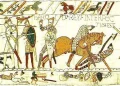
2026 marks the 960th anniversary of the Norman Conquest. To celebrate, our weekly newsletter is embarking on a year-long journey through the Bayeux Tapestry.
Every week, we “unroll” a new panel, decoding the secrets, the drama and the history of 1066.
Join thousands of fellow medievalists and sign up for free.