By the mid-1020s, Cnut the Great was arguably the most powerful man in Northern Europe. As the king of England and Denmark, he was no longer just a Viking warlord but the ruler of the North Sea Empire. Cnut was rebuilding the empire first forged by his father, Sweyn Forkbeard, reclaiming it piece by piece. His influence stretched from the Irish Sea to the Baltic.
The King of Sweden, Anund Jacob, and the King of Norway, Olaf II Haraldsson, watched Cnut’s power steadily grow in the region. His dominance was a threat to their kingdoms. If Cnut secured full control of the Baltic trade routes, Sweden and Norway risked slipping into dependency, reduced to tributary states within his empire.
In 1026, opportunity presented itself. While Cnut was occupied administering his English realm, Anund and Olaf struck first, launching a joint assault on Denmark. It was a gamble, a preemptive strike intended to exploit Cnut’s absence and force him into a confrontation on terms of their choosing.
Cnut responded with characteristic speed and resolve. He gathered a vast fleet, with some sources estimating as many as 600 ships. His flagship was a massive dragon ship over 260 feet long. Cnut sailed to meet the invaders at the mouth of the Helgeå, the “Holy River,” in southern Sweden.
A Weapon Made of Water
When Cnut’s fleet reached the river estuary, they found the combined Swedish and Norwegian fleets already in position. Yet the allies did not immediately attack. In the eleventh century, naval combat was essentially infantry warfare afloat: ships were lashed together into floating fortresses, and sailors fought hand-to-hand, with victory usually going to the side with greater strength.
Anund and Olaf were outnumbered and couldn’t rival Cnut’s fleet size or manpower. Instead, they turned to the terrain and a form of warfare that transformed nature into a weapon.
Swedish and Norwegian engineers labored upstream. Using peat, heavy timber, and boulders, they created a temporary barrier across the Helgeå. Whether it was a true dam or a controlled obstruction, the effect was the same. Water backed up behind the barrier, swelling into a temporary reservoir as the allies waited, watching wind and tide.

As Cnut’s fleet sailed into the estuary, the dam upstream was breached. Sources differ on the precise mechanics, but all concur on the result: the deliberate release of pent‑up water against Cnut’s ships.
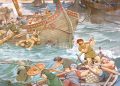
A roaring wall of water surged downstream, filled with timber and debris. The flood slammed into the Danish ships with catastrophic force. Heavy logs became unguided missiles, smashing hulls and snapping masts. Ships collided, anchors dragged, and men were thrown overboard into a torrent thick with splintered wood and mud. Before a single spear was thrown or arrow loosed, Cnut’s forward elements were thrown into chaos and suffered heavy losses.
The Aftermath
The flood, for all its ingenuity, did not annihilate Cnut’s fleet. Its sheer size worked in his favor. While the ships caught in the estuary were badly damaged, much of his fleet lay beyond the main path of the flood and remained intact.
As the waters receded, Cnut restored order with remarkable discipline. His ships reformed, lines were redrawn, and the Danish fleet once again presented a coherent front.
Kings Anund and Olaf, having expended their offensive strategy, now faced the grim reality of conventional warfare against a numerically superior enemy. They withdrew their forces rather than risk a catastrophic defeat at the hands of Cnut.
The Anglo-Saxon Chronicle records heavy losses among Cnut’s Danish and English forces and credits the Swedes with holding the battlefield:
This year King Cnut went to Denmark with a fleet to the holm by the holy river; where against him there came Ulf and Eglaf, with a very large force both by land and sea, from Sweden. There were very many men lost on the side of King Cnut, both of Danish and English; and the Swedes had possession of the field of battle.
Legacy

The Battle of the Helgeå stands out in Scandinavian tradition as a moment of daring ingenuity, where inferior numbers briefly checked superior power through environmental mastery.
Its true significance lies in what followed. Cnut exploited the weakened position of King Olaf Haraldsson, used diplomacy and bribery to undermine Norwegian nobles, and within two years, secured the Norwegian crown for himself. By 1028, Cnut’s North Sea Empire reached its greatest extent, encompassing England, Denmark, Norway, and influence deep into Sweden.
Helgeå did not break Cnut’s empire, but it revealed that even at its height, imperial power could be disrupted by local knowledge, ingenuity, and the mastery of terrain.