For much of the Middle Ages, the pope was far more than a spiritual leader. He was a kingmaker, a political rival, a reformer, and at times, scandalous. In this installment of The Medieval Papacy, we explore the life and legacy of one of history’s most powerful popes, a man whose decisions reshaped medieval Europe.
Pope Leo III
On a crisp morning in April 799, the streets of Rome ran with blood but not from a soldiers. It was the blood of the Pope. During a solemn religious procession, a gang of armed conspirators, led by relatives of the previous Pope Hadrian I, ambushed Leo III. Their goal was as brutal as it was symbolic: they intended to gouge out his eyes and cut off his tongue, physically maiming him so that he would be unfit to hold the papacy.
Leo survived the assassination attempt, but he was left a prisoner in a local monastery, his authority shattered. This moment of violence would set in motion a chain of events that changed the map of Europe forever, culminating in the most famous Christmas Day in history and the birth of an empire that would endure for a thousand years.
The Outcast on the Throne
To understand why Leo was attacked, one must understand Roman politics. Unlike many of his predecessors, Leo III was not a member of the high Roman aristocracy. He was a commoner who had risen through the Church ranks based on administrative skill. To the noble families of Rome, he was an interloper, a “new man” who didn’t belong on the Throne of Peter.
They accused him of perjury and adultery, charges designed to ruin his reputation. When the physical attack in 799 failed to fully blind him (his supporters later claimed his sight was miraculously restored), Leo realized he couldn’t survive in Rome alone. He scaled the monastery walls, escaped his captors and fled across the Alps to find the only man powerful enough to save him: Charlemagne, King of the Franks.
The Meeting at Paderborn
The meeting between the battered Pope and the giant Frankish King took place at Paderborn, in modern-day Germany. It was a collision of two worlds. Charlemagne was at the height of his power, having conquered the Saxons and the Lombards, yet he was still technically just a “King.”
Charlemagne agreed to escort Leo back to Rome and clear his name. In return, the Pope would offer the Frankish King something that no amount of military conquest could buy: Imperial legitimacy.
The Trial of the Century
In November 800, Charlemagne arrived in Rome with a massive army to “restore the state of the Church.” This was a delicate legal moment. According to Church law, the Pope could be judged by no man, Prima Sedes a nemine iudicatur. To solve this, on December 23, Leo performed a “Purgation Oath.” Standing before a grand assembly of Frankish and Roman lords, he held the Gospels and solemnly swore he was innocent of all charges.
The Christmas Coronation
Two days later, on Christmas Day 800, Charlemagne knelt in prayer at the altar of the old St. Peter’s Basilica. As he rose, Pope Leo III stepped forward and placed a heavy golden crown upon his head. The Roman crowd, coached or perhaps caught in the spirit of the moment, erupted in a pre-planned shout: “To Charles, the most pious Augustus, crowned by God, the great and peace-giving Emperor, life and victory!”
For the first time in over 300 years, there was an Emperor in the West. This was the birth of what would become the Holy Roman Empire.
🏰 Medieval Archives Weekly
Love stories like this? Every week we deliver papal struggles, forgotten battles and royal intrigue of the Middle Ages
2026 Special Feature
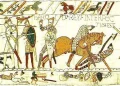
2026 marks the 960th anniversary of the Norman Conquest. To celebrate, our weekly newsletter is embarking on a year-long journey through the Bayeux Tapestry.
Every week, we “unroll” a new panel, decoding the secrets, the drama and the history of 1066.
Join thousands of fellow medievalists and sign up for free.