After more than a decade of forensic analysis and centuries of disruption, the commingled remains of some of England’s earliest kings, bishops, and a formidable queen were reinterred, marking the conclusion of one of the most ambitious archaeological projects in modern church history.
A Royal Jigsaw Puzzle
For centuries, six painted wooden mortuary chests perched atop the cathedral’s presbytery screens were believed to hold the remains of Anglo-Saxon royalty and bishops from the 7th to the 12th centuries. The names inscribed in Latin on the chests read like a roll call of early English power: Kings Cynegils, Cynewulf, Ecgbert, Aethelwulf, Eadred, Edmund, Cnut, and William Rufus, alongside Bishops Wine and Alwine, and Queen Emma of Normandy.
However, the contents of these chests had been notoriously disturbed. During the English Civil War in 1642, Parliamentarian soldiers ransacked the cathedral. According to local lore and historical accounts, the soldiers “threw down the chests” and used the sacred bones as missiles to smash the cathedral’s stained-glass windows. When the monarchy was restored, the scattered remains were swept up and returned to the chests, but without any way to know who was who. As a contemporary chronicler famously noted, “kings were mixed with bishops and bishops with kings.”
“This project demonstrates the combined power of science, the study of human remains and historical research to discover new information about the six mortuary chests and their occupants which would not have been available to us a generation ago.”
Eleanor Swire, Winchester Cathedral Curator
The Science of Sorting
In 2012, the cathedral launched the Mortuary Chests Project to untangle this royal jumble. It became a massive detective story involving biological anthropologists, radiocarbon dating experts, and historians.
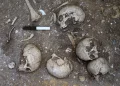
Over the last 14 years, researchers from the University of Bristol and other institutions have meticulously examined over 1,300 individual bone fragments. By 2019, the team had successfully reconstructed 23 partial skeletons. Among the most thrilling potential identifications was that of Queen Emma—a powerhouse of the medieval world who was the daughter of Richard I of Normandy, the wife of two English kings (Ethelred the Unready and Cnut), and the mother of two more (Edward the Confessor and Harthacnut).

“This project demonstrates the combined power of science, the study of human remains, and historical research to discover new information about the six mortuary chests and their occupants which would not have been available to us a generation ago,” said Eleanor Swire, the curator at Winchester Cathedral.
The Reinterment
The reinterment process, which culminated today, was guided by radiocarbon dating. Rather than attempting to force a definitive identity onto every fragment, the project adopted a respectful scientific approach: individuals from similar time periods have been placed together in the same chests.
While the six historic chests have been returned to their places of honor, they could not hold everyone. The cathedral has announced permission to commission two new chests to house the remaining bones, ensuring that every individual recovered from the Civil War desecration is accorded a dignified final resting place. Details on these new reliquaries are expected to be released later this summer.
A Final Resting Place
Today’s service closes a chapter of disturbance that began nearly 400 years ago. The bones of the founders of the English monarchy, once used as weapons of war, are now back where they belong—safely housed within the cathedral that many of them helped to build.1
“We cannot be certain of the identity of each individual yet,” Professor Kate Robson Brown noted during the project, “but we are certain that this is a very special assemblage of2 bones.”
For the worshippers and historians gathered in Winchester today, the certainty of their identity mattered less than the certainty of their peace. After centuries of chaos, England’s ancestors are finally at rest.